Tuesday, August 31, 2010

It Begins Again... (AT&T)

I've been enjoying stable "Elite" DSL service (6 Mb/s download) for about 5 years now.  Time to update to AT&T's "Uverse" service?  It just arrived in my neighborhood.


Southern New England TelephoneImage via WikipediaMy initial DSL service was a pretty grim story. SBC took over the Connecticut territory from SNET not long before.  (SNET, of blessed memory, was a member of the original Bell network, having been Connecticut's own phone company for a very long time.  Sigh!)


Surely, AT&T would have figured out their new Uverse TV/Internet/Voice technology by now. Nothing can go wrong, go wrong, go wrong.

Actually, they've made 3 errors so far just scheduling the installation, and I've had to talk to 4 or 5 people on the phone.

The interesting technical issue is that their internal database shows that I am supposed to be 733 feet from the "node" (VRAD) in my neighborhood.  But, tracking real phone cables, I come up with some long zigs and zags that may add up to triple that number.  So there's a chance the tech will show up (at the newly appointed hour, we hope) and declare that my connection would be substandard.  And the whole thing is off.

I'm not canceling my Comcast TV just yet.

Tuesday, August 03, 2010

Required Reading (FCC)

Image via Wikipedia
Logo of the United States Federal Communicatio...
(From the FCC Dept. of Ugly Logos)
My Amateur license is coming up for renewal.  Logging in to the FCC's Universal Licensing System (ULS) to make a correction, I came across this interesting language:
Amateur or GMRS applicant/licensee certifies that the construction of the station would NOT be an action which is likely to have a significant environmental effect (see the Commission's rules 47 CFR Sections 1.1301-1.1319 and Section 97.13(a) rules (available at web site http://wireless.fcc.gov/rules.html).

Amateur applicant/licensee certifies that they have READ and WILL COMPLY WITH Section 97.13(c) of the Commission's rules (available at web site http://wireless.fcc.gov/rules.html) regarding RADIOFREQUENCY (RF) RADIATION SAFETY and the amateur service section of OST/OET Bulletin Number 65 (available at web site http://www.fcc.gov/oet/info/documents/bulletins/).
 So I guess I better read up:
Then there is the ARRL book "RF Exposure and You" by Ed Hare. ($22.95 from ARRL or $9 used at Amazon.com)  That's on my shelf, as it happens. Now I better crack it open.

Silly me, I thought applying for and receiving an FCC license meant you agreed to follow the rules.  But no, I have to promise extra hard and agree to read all this in advance.

Glad to know every other ham has done that!

Sunday, July 25, 2010

QS1R SDR QST Review

My first-ever product review for QST is coming in the September, 2010, issue.  This is for the Quicksilver QS1R Software Defined RadioARRL members may find it here. [pdf]

Thursday, July 22, 2010

Pillar Question

I note that ARRL now has "five pillars", recently up from four. But wait, there are five pillars of Islam, too. Some forms of Buddhism have ten pillars. So what's this about "pillars"?

Inquiring minds want to know how many pillars are optimum. We consult the oracle - Google - with a request to find all occurrences of "N pillars" - from "One pillar" to "twenty pillars". The following is the result -- worthy of deep contemplation.

Monday, May 31, 2010

Memorial: The Audion


One of the neatest displays at ARRL headquarters is in the W1AW station entry -- a couple of early radios using the DeForest Audion. You have to know where to look for them. The League is many things, but it lacks a real museum curator.

Remember the Audion here. (Gizmodo)

Wednesday, May 26, 2010

Ubuntu Hams!


Are you into software development, Ubuntu Linux, Amateur Radio? Then you need to know about Ubuntu Hams!

Sunday, May 23, 2010

Weird Words: Wattage, Architect

Some words bother me. Maybe I'm showing my age, I know. But consider.

Wattage - The better word is "power" or "power rating". A 60 Watt light bulb has a 60 Watt power rating. A 10 Watt bulb is a low power bulb.

On the other hand, "wattage" is a parallel of "voltage", and I don't have the same reaction to that word. The "correct" words would be "potential" or "electromotive force".

Then why don't we say "amperage", "ohmage", "faradage", or "henryage"? Actually, I do hear "amperage", but not commonly.

[We seem to have some confusion between a quality (power) and the unit used to measure the quality (the Watt). In economics, there is something similar. The currency system may be called Stirling or RenMinBi, while the unit is the Pound or the Yuan. In the US, alas, we can only say "the Dollar" for both.]

Architect - When did we start using "architect" as a verb? I think I noticed it first in the computing world in the late 1980's. Why isn't "design" good enough? Maybe we IT gurus want to give the impression that we are a cut above traditional engineering professions? (Alas, the opposite is more often true.)

That's all for now from your local curmudgeon shop.

Friday, April 23, 2010

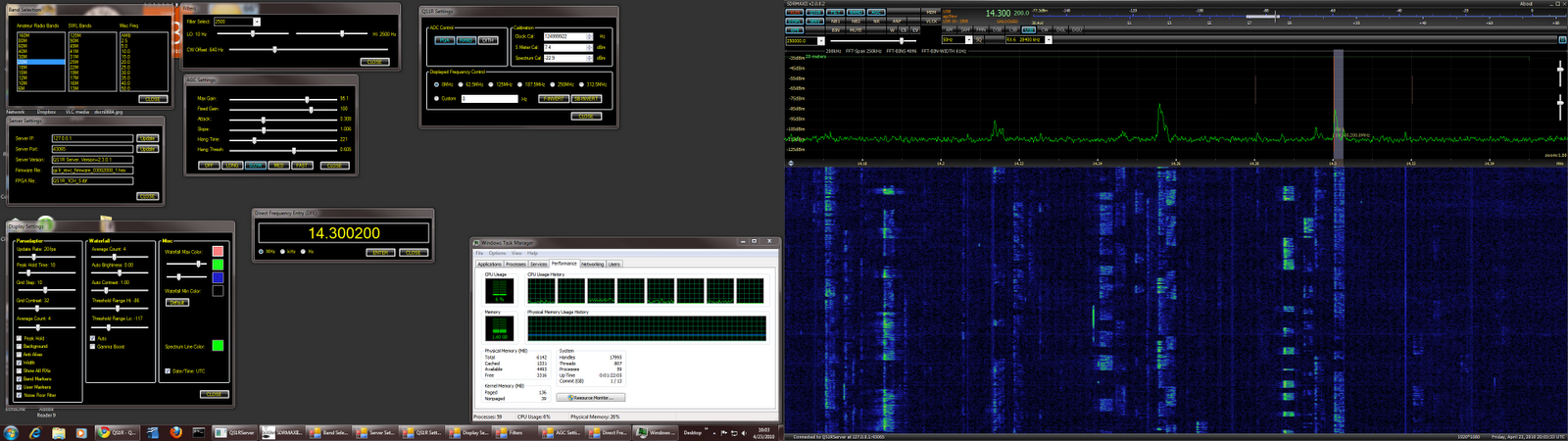
Fiddling with the QS1R

I'm working with the Quicksilver QS1R receiver, a little SDR box that samples the spectrum from 10 kHz to 60 MHz. The hardware seems good, but most of the action for the user is in the "S" part of SDR -- i.e., the software. Take a look at 20 meters in the afternoon - with all possible windows open. (To be fair, you don't need twin monitors -- 3840 x 1080 pixels -- to use this radio!) CPU demand is 6% on my 4 core, 8 thread system, Windows 7 (64 bit). Click for higher rez.