
This is a long posting about what was and what might have been. It's about how hard it is to get data without preparation and without "pro" tools, but how you can dig something even out of poor results.
This is about the NASA
STS-119 Space Shuttle launch that occurred at 7:43 pm EDT on the evening of March 15, 2009. This was billed as an unusual opportunity, because it was to take place just as the sky was darkening over the East Coast. The
trajectory was to send it into an orbit with 51 degree inclination, to catch the International Space Station. That takes it more or less parallel to the Eastern Seaboard of the US. Would it be visible at Branford, CT? (lat 41d 15m 09s, long 72d 50m 02s W)
Earlier in the day, I heard about the launch and the viewing opportunity. I set an alarm to remind myself, but otherwise did not think to prepare.
The alarm rang, I looked out the window and surprisingly the sky was mostly clear. There was some haze that obscured the stars below about 20-30 degrees elevation, over Long Island Sound. (Fortunately, from my back yard I have a clear view to the south, east, and north over water.)
I connected to NASA TV with my PC using
Livestation, and watched the actual liftoff starting. Without much thought, I picked up my new little video camera (a cheap Polaroid DVC-00725F, bought from Woot.com), dimmed my living room lights, and headed out into the cold and almost dark yard.
Without any detailed trajectory analysis that would tell me the apparent track of the Shuttle as it was to come by Connecticut, I stood watching the southern sky for things that move. (It doesn't help that we are under the main approach to Hartford/Springfield airport from the south, but aircraft are generally easy to identify by their flashing lights, etc.)
I fiddled with the vidicam a bit, not ever having tried it for "astrovideography". I thought I knew how to make it work, although there are quite a few problems for this application. It's handheld, of course. It has an LCD screen which is annoyingly bright and very hard to use to point at "stellar" objects. The autofocus feature (no manual setting) makes it likely to go out of focus if you try to zoom. The zoom magnification is not calibrated and so on. I discovered later that the camera has a "night" mode, but there is no documentation of what that actually does. In any case, I did not use it.
A crucial missing piece of equipment, as it turned out, was a timekeeping device, or so I thought at the time. In fact, I now realize the camera has a clock that I am able to calibrate as being about 42 seconds slow.
I noticed something coming north toward me, so I began an HD recording. From the file date and time, I find that it started at 7:52:28 pm EDT. The launch time was 7:43 pm, so our video starts 9 minutes after launch. According to the CBS trajectory prediction, the Shuttle was at about 1,000 miles downrange from Cape Canaveral at that point, about 65 miles altitude, traveling at over 17,000 mph. Google Earth tells me that the distance from Canaveral to Branford, CT is very close to 1,000 miles as the crow flies. That fits, but I have no way to know what track across the sky I should have expected.
VisualWas it STS-119? Before considering the video, what did I see as a visual observer? It was very fast -- about 2 degrees/sec at closest approach (estimated from video). That's much faster than commercial air traffic at altitude. It was completely silent, and it was brightest as it was moving
away from me to the northeast, perhaps comparable to Sirius. It had an unusual extended appearance (to the eye) as it moved past, and it appeared as a very close visual binary object (i.e., double) with perhaps a few arc minutes separation as it moved away. There was no flashing light, as normally seen on commercial aircraft. At the time, I thought it probably was not the Space Shuttle, but now I am not sure what it was.
SkyThe sky at the time was graphed by
Stellarium -- extremely helpful for celestial navigation! Here is a partial snapshot of the theoretical sky:
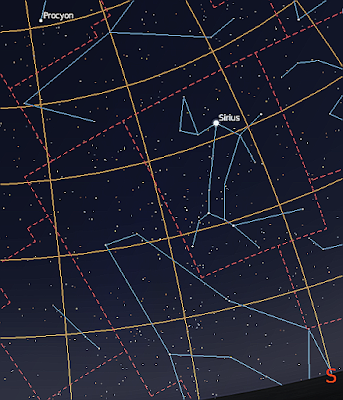
Conveniently, the bright stars Sirius (m -1.45) and Procyon (m 0.4) are separated by about 25 degrees on the sky and were near the track of the "object", providing good calibration points.
VideoThe full 42 sec. video is available for download at my
aa6e.net site. (10 MB AVI format) I learned more than I wanted about video processing in Linux to get this video into a usable state. It needed to have its brightness and contrast adjusted to bring up the faint images that are just above the noise level. (An upload to YouTube was a failure, since their processing degrades the quality, even in "HD" mode.) Note that your computer may or may not have the power to play this video at full speed and resolution. It is 30 fps, 1280 x 720 pixels, mpeg4 encoded. (My Athlon XP 2000+ is barely able to manage.)
Because of the limitations of the recording, you may wonder if there's anything useful there at all. But there is!
I constructed a timeline for the video:
Start (07:52:28 pm EDT +/- 1 sec)
+ 00 s: Sirius in view
+ 11 s: Object appears faintly about 150 pixels away from Sirius on a vector about 50 degrees clockwise from "vertical". Diffuse with reddish hue.
+ 15 s: Object passes "above" Sirius (vector 0 degrees).
+ 17 s: Sirius passes out of frame, but object continues
+ 21 s: Procyon enters frame (upper left)
+ 23 s: Object passes out of frame. Some structure (non stellar)
+ 35 s: Procyon leaves frame (right)
+ 38 s: Object re-enters frame, binary point source, bottom center
+ 42 s: Recording ends
Closest approach (highest elevation) would have been about 07:52:51.
If you are not able to view the video, I can present portions of a few of the final frames showing the double object.
AnalysisThis is pretty crummy data, acquired impromptu with a marginal recording device. Still, given the stellar calibrations and the timing, some information can be extracted.
First, how fast was the object moving? Tracking it as it moved from the neighborhood of Sirius to Procyon, it was moving at roughly 2 degrees/second. If the range is 100 miles, the linear velocity would be over 12,600 mph, depending on the projection angle. If it were an aircraft at 5 miles range, it would be traveling over 630 mph.
What about the double structure? The final video frames show a binary separation of about 4 pixels, which corresponds to 0.08 degrees or 4.8 arc minutes -- given a very sketchy idea of the horizontal field of view being 25 degrees. (A guess based on the apparent Sirius - Procyon separation.) The resolution limit of the human eye is said to be about 1 arc minute, and given that the double object was fairly clear, our estimate of 4.8 minutes is not unreasonable.
If the object were at 100 mile range, what would the separation be? I work out 737 feet! From NASA info, the Shuttle wingspan is 78 feet, somewhat more than the separation of the two boosters. However, if the range were 5 miles, the separation would be 36 feet, also large for typical military jets.
We are left with a mystery. The time and angular speed suggest that we were seeing STS-119, although quite possibly it should have passed lower in the east -- in our haze layer. The fact that the object was brighter moving away than moving towards us suggests rocket engines or a military jet (afterburners?), but the separation of the double point image is puzzling -- in either case.
So it was a
UFO... at least until or unless we find an error in calculation (it has happened before) or more data come to light. Do readers have any suggestions?
Update: A number of other on-line sighting reports as STS-119 passed "over" Connecticut, but I have still found nothing more quantitative about trajectory or timing. Was the Shuttle flying over land or over the Atlantic? (Early in the launch, it has to be over water for safety, but probably not this far into the flight.) If it was strictly over ocean, it would have had to fly 50 or more miles to the east, which might not be compatible with my observation.
The surprising separation of the "binary" receding view might (with some hand-waving) be explained if the visible light comes from large exhaust plumes rather than the engines themselves. Also, the separation reported above is likely to be an over-estimate, because I measured those frames that showed a clear separation. Many frames are more muddled, but still show an extended image along the same axis. The average apparent separation might be say 2 arc minutes, and it could even be less, if the video zoom factor was larger than estimated.


