Showing posts with label propagation. Show all posts

Sunday, November 17, 2019

On the air with new antenna!


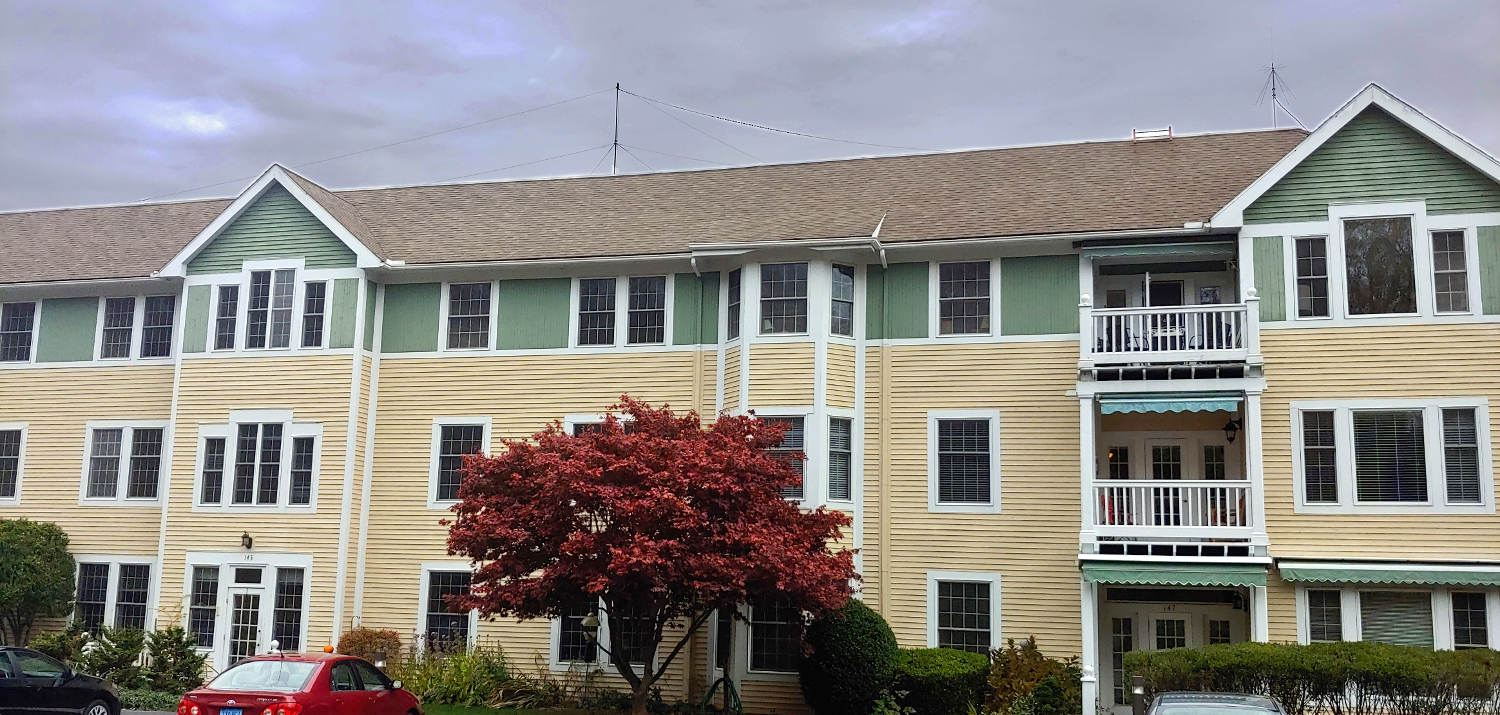
You can see our new 86 ft inverted-V-non-resonant dipole on top the "Whitfield" building at Evergreen Woods, our new QTH.  Fed by 400 ohm ladderline to our 2nd floor apartment at the right, it was a long slog to get installed.  Lots of help from friendly facilities staff, however.  A 4:1 balun connects our ladderline to either the Flex-6500 directly or through a Heathkit SA-2060A Antenna Tuner.

First test shows it's a good 40 M antenna, easily matched with the built-in ATU of the Flex-6500.  Other bands can be a challenge, but the SA-2060A will tune this system over 160 - 6 M -- at least if you're willing to crank those knobs!

My first on-air test was on 80 M with the SA-2060A.  This is a difficult match, because the 86 ft dipole is close to a quarter-wave at 3.6 MHz.  Does it work?  I set it up with WSPR at 5 W transmit power to see what came back.  Partial results of the first few minutes:

Timestamp Call MHz SNR Reporter RGrid km az
2019-11-18 02:36 AA6E 3.570022 -24 HB9TMC JN46lj 6279 55
2019-11-18 02:38 AA6E 3.570021 -24 PA0O JO33hg 5815 48
2019-11-18 02:36 AA6E 3.570022 -24 TF1VHF HP84wl 4091 34
2019-11-18 02:34 AA6E 3.570025 -27 KA7OEI-1 DN31uo 3263 284
2019-11-18 02:34 AA6E 3.570023 -18 VE6JY DO33or 3250 309
2019-11-18 02:38 AA6E 3.570022 -27 KX3DX DM79 2723 276
2019-11-18 02:34 AA6E 3.570022 -25 N6GN/K DN70ll 2697 279
2019-11-18 02:34 AA6E 3.570022 -26 N5SNT EL09wq 2618 249
2019-11-18 02:38 AA6E 3.570018 -25 KI5WA EM11jk 2435 251

So I think we pass.  Best DX is HB9TMC in Switzerland, 2279 km = 3901 miles, with a Kp index of zero suggesting OK propagation..

I had been worried about interference from our building HVAC and other systems. It's there, but so far it's no show-stopper.  My first tests, inside the apartment, were a total disaster, but being 20-25 feet above the roof gets rid of most of it.

Friday, September 08, 2017

Don't believe everything you read (Kp=5)

(tnx N3KL, NASA)

The news is all about the "Major Solar (Geomagnetic) Storm" we are having.  Points:
  • No aurora visible last night (lat 41 deg), but Moon was very bright.
  • Kp (Planetary K index) is supposed to be 5 now (quite high), and it was up to 8 last night. But the 20 meter ham band is hopping.  I just bagged my first digital T77 (San Marino).
  • If it weren't for the news, I'd say 20 meter (14 MHz) conditions are fairly normal, but 15 and 17 meters (21 and 18 MHz) are largely dead.
Sometimes it's better not to know too much.

Wednesday, September 06, 2017

End of the world, coming into view?

Solar cataclysm (for shortwave radio folks) is happening right now.


The red shows the absorption of radio waves around the globe, with the center in the current sub-solar point (where it is noon).


We have "R3" radio blackout conditions.  (All from http://www.swpc.noaa.gov)

In addition to this, we have a "CME" (coronal mass ejection) of high-speed charged particles generated by a previous flare event that is supposed to hit us today, causing a geomagnetic storm that should further screw up the HF airwaves.  You probably won't lose your electric power, however, but you might get to see the aurora borealis tonight -- if it's not raining cats and dogs.

And, there are big thunderstorms outside.

And, there are two big hurricanes out there somewhere -- not in New England (yet) fortunately for us.

And lots of trouble coming from DC and some other world capitals.

Saturday, May 04, 2013

Lousy Saturday on 40 meters


Solar weather (M class flare) makes the low HF bands very quiet this morning! Some day I have to dig in and understand the scale on this map.  It says we're affected by "1 dB" on 40 meters, but I'd say it's more like 30 dB from listening on the band.

Check http://www.swpc.noaa.gov/drap/global.html for the latest.

Tuesday, June 14, 2011

The Sun may be headed for a little quiet time


"Is the solar cycle shutting down?
New results indicate it may very well be, at least temporarily. Even though the Sun is currently approaching the peak of its cycle in 2013, and we’re seeing an increase in activity (more sunspots, flares, and other violent events), there are strong signs that the next expected peak (in 2022 or later) may be weaker, or may not come at all! ..."
(Read more from Phil Plait's Bad Astronomy blog...)

Sunday, December 12, 2010

ARRL 10 Meters

I thought I would skip the 10 M contest -- too much happening on the family / holiday front, and surely the band is going to be dead. Well...

BrazilImage via Wikipedia
I checked in this afternoon just to see, and by golly there were openings to the south (FL - Caribbean - Brazil) and to the west (XE and W6).  Along with some local folks.  I ended up with 16 mighty Q's and 13 multipliers.  And I resisted the temptation to use the afterburner!  Ten meters is a low-power band, right?

Now, I'm a believer in gray-line propagation.

Monday, February 15, 2010

12 meter DX

The 24.9 MHz band was popping this morning. Worked SV3 (Greece) and YV1 (Venezuela) for fun. Solar activity is helping a lot.

Monday, February 08, 2010

Sun's a-poppin

Phil Plait of Bad Astronomy Blog compiled this neat video of what the Sun has been doing for us lately:

Wednesday, December 16, 2009

Hawaii, as you like it.

Checking the solar weather, you will see there has been some real sunspot activity lately. Is that a good enough reason to check out the HF bands? You bet!

There was exactly one SSB signal on 15 meters, and it was Jerry, AH6V on the Big Island of Hawaii. He was a good S7 here in CT, a very steady and clear signal. Turns out he was running 300 W using exclusively solar power! That's remarkable -- an inspiration, even.

We had a pleasant QSO. I was able to tell him about my new solar garden light system that struggles to produce a couple of mA for a few hours after sunset in the New England winter...

Where were all the rest of the Hawaiian hams?

Saturday, September 05, 2009

Amateur Radio vs HPC & OSS

Lately, I've been wondering what aspects of Amateur Radio would benefit from high performance computing technology. This is prompted by my latest PC - built around an Intel Core i7 processor with 6 GB of RAM. This CPU has 4 cores and 8 logical (hyperthreaded) processors. The benchmark results are very nice: 20,500 Whetstone MIPS (floating) and 45,200 Dhrystone MIPS (scalar) across 8 simultaneous threads. [BOINC's built-in benchmarking - not to be taken at face value!] In addition, we have graphics processors (GPUs) that can be programmed with CUDA, OpenCL, and similar methods.

Some general areas that occur to me:

  • Digital Signal Processing (Audio-ish) - This is the technology behind much of today's Software-Defined Radio (SDR). A significant amount of processing is required for mixing, modulating, and demodulating signals. Dynamic spectral displays are useful. However, the actual amount of horsepower required for typical amateur applications is fairly limited. In most cases, the bandwidth of interest is less than 128 kHz (the range of high-end audio cards for band monitoring displays) and very often less than 3 kHz - the maximum audio bandpass of most communications transceivers. As long as we are working with audio-type signals - PSK31, Olivia, RTTY, and SSB, we are not likely to tax the latest CPUs. You can use more power if you want to listen to many channels at once, but even so...
  • DSP (Video) - Modern HDTV signals require a lot of processing. In production work, this would mostly be done in special-purpose processors (I think), but amateurs might prefer to operate with commodity PC and GPU hardware. I am not aware of amateur HDTV work for over the air transmission, but there may well be some. My initial look at HDTV (and DTV) was discouraging. The sheer numerology of options is overwhelming -- although of course, you may only need one mode for ham work.
  • DSP (Video 3D) - How about ham communications through 3D immersive environments? Four-pi visual fields, multichannel sound: you could get the gamers into that! (But why ham radio? Why not FIOS-type connections? We can offer off-grid operation and mobility away from cell towers!)
  • Radio Science - Propagation Analysis and Prediction through detailed atmospheric modeling, ray tracing, etc. This could be extended to real-time monitoring of the HF bands at points around the world, and trying to build up a real-time DX prediction service.
  • Exotic wideband signalling. Using microwave bands and pursuing highest bandwidths. Would this be more a question of very fast D/A conversion and I/O more than general purpose computing?

There must be more areas for HPC in Amateur Radio. As a long-time HF operator, I'd like to be able to translate CPU power into greater sensitivity and interference rejection. We can certainly consider computationally intensive modulation and demodulation schemes, but it's not clear what returns are available in a channel's SNR given the practical limits on transmitter power, modulation bandwidth, antennas, etc. The ionosphere degrades the signal so that frequency resolution below about 1 Hz or so is not going to be very productive. How can a "supercomputer" overcome that?

Ideas, anyone?

[This is cross-posted with my SourceForge blog: http://sourceforge.net/userapps/wordpress/aa6e/. Why do I have an SF blog? For topics relating to open source software, to see what WordPress is all about? Something like that!]

Tuesday, March 31, 2009

Why good QSOs go bad (propagation)

KB6NU has an interesting propagation question about why good QSO's go to pot.

This evening, just after dark, I called CQ on 40m CW. On the second call, VE3QO, in Ottawa, ON replied to my call. On that first transmission, he was at least 10 dB over S9... Unfortunately, on the next go-around, VE3QO was a lot weaker, and on his third transmission he was nearly unreadable.

...

My question is what propagation mechanism is causing this behavior? Is it perhaps the combining of the F1 and F2 layers? If that’s the case, why is the calling station so unusually strong on the first transmission?

OK, I'll bite. I've had similar experiences, not always at sunset. I call CQ -- or answer a CQ -- and signal reports are 59+. After a few minutes, we're both down in the mud. On one level, that's a selection effect. We are more likely to call or be called if the propagation is very good -- we answer the strong stations first. Statistically, you'd expect to start talking to people at a prop. maximum, and things will naturally get worse from there, sometimes dramatically.

My hand-waving "scientific" explanation for both the sunset ("gray-line") and the variability issues comes down to thinking of the ionosphere as a time- and spatially variable propagation medium. We get strong skip when there are (a) strong gradients (acting as mirrors) in ionospheric conductivity (as around sunrise/sunset) and (b) when the gradients have a favorable geometry for a given path. E.g., they tend to lie on ellipsoids that have the two stations as foci, and the ellipsoids are arranged (in Fresnel zones) so that multiple paths arrive in phase.

So it's no surprise that we see a range of signal strengths. Why do we get such a range? We get momentary deep nulls when signals arrive out of phase and cancel. Maybe the question is why do we see the opposite - short periods of very strong propagation? Again, with hand waving, it is reminiscent of the "cusps" you see, for example, on the bottom of a sunlit swimming pool, as the more or less random waves act as lenses that focus light in very bright lines.

Friday, October 03, 2008

NYT: Sunspots Are Fewest Since 1954, but Significance Is Unclear


See New York Times article. The prospects for "Cycle 24" are especially interesting for hams who use the "high frequency" (HF) bands, 3 - 30 MHz. We need those sunspots!

Thursday, June 12, 2008

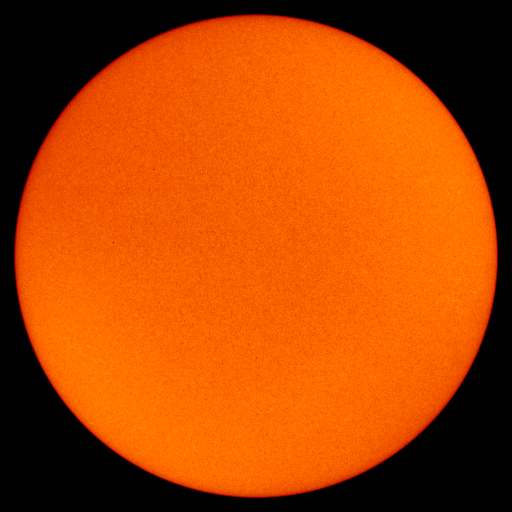
Zero Sunspots?


From Ian O'Neill at universetoday.com this cheerful thought:
So what's up with our Sun? Is it going through a depression? It seems as if our closest star is experiencing a surprisingly uneventful couple of years. Solar minimum has supposedly passed and we should be seeing a lot more magnetic activity, and we certainly should be observing lots more sunspots. Space weather forecasts have been putting Solar Cycle 24 as a historically active cycle… but so far, nothing. So what's the problem? Is it a ticking bomb, waiting to shock us with a huge jump in solar activity, flares and CMEs over a few months? Or could this lack of activity a prelude to a very boring few years, possibly leading the Earth toward another Ice Age?