Showing posts with label antennas. Show all posts

Sunday, November 17, 2019

On the air with new antenna!


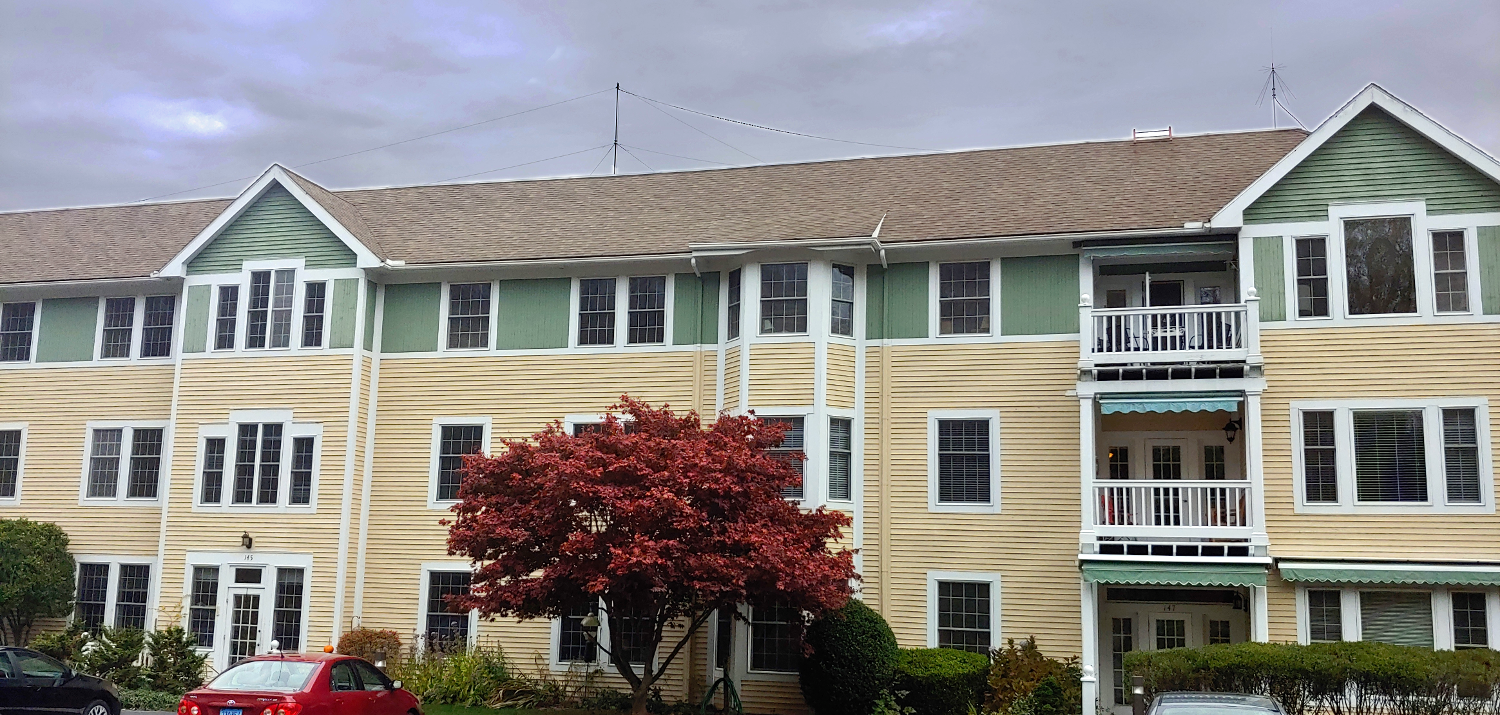
You can see our new 86 ft inverted-V-non-resonant dipole on top the "Whitfield" building at Evergreen Woods, our new QTH.  Fed by 400 ohm ladderline to our 2nd floor apartment at the right, it was a long slog to get installed.  Lots of help from friendly facilities staff, however.  A 4:1 balun connects our ladderline to either the Flex-6500 directly or through a Heathkit SA-2060A Antenna Tuner.

First test shows it's a good 40 M antenna, easily matched with the built-in ATU of the Flex-6500.  Other bands can be a challenge, but the SA-2060A will tune this system over 160 - 6 M -- at least if you're willing to crank those knobs!

My first on-air test was on 80 M with the SA-2060A.  This is a difficult match, because the 86 ft dipole is close to a quarter-wave at 3.6 MHz.  Does it work?  I set it up with WSPR at 5 W transmit power to see what came back.  Partial results of the first few minutes:

Timestamp Call MHz SNR Reporter RGrid km az
2019-11-18 02:36 AA6E 3.570022 -24 HB9TMC JN46lj 6279 55
2019-11-18 02:38 AA6E 3.570021 -24 PA0O JO33hg 5815 48
2019-11-18 02:36 AA6E 3.570022 -24 TF1VHF HP84wl 4091 34
2019-11-18 02:34 AA6E 3.570025 -27 KA7OEI-1 DN31uo 3263 284
2019-11-18 02:34 AA6E 3.570023 -18 VE6JY DO33or 3250 309
2019-11-18 02:38 AA6E 3.570022 -27 KX3DX DM79 2723 276
2019-11-18 02:34 AA6E 3.570022 -25 N6GN/K DN70ll 2697 279
2019-11-18 02:34 AA6E 3.570022 -26 N5SNT EL09wq 2618 249
2019-11-18 02:38 AA6E 3.570018 -25 KI5WA EM11jk 2435 251

So I think we pass.  Best DX is HB9TMC in Switzerland, 2279 km = 3901 miles, with a Kp index of zero suggesting OK propagation..

I had been worried about interference from our building HVAC and other systems. It's there, but so far it's no show-stopper.  My first tests, inside the apartment, were a total disaster, but being 20-25 feet above the roof gets rid of most of it.

Thursday, August 15, 2019

Casing the Environment


We have completed our move to Evergreen Woods, at least to the point of unpacking many of our boxes of "stuff".  Time to check out the Electromagnetic Environment. 

It's not all good or all bad. The fact is that we're inside a fairly large complex of 249 apartments and commons buildings.  We are in a rural/suburban setting, but the buildings have complex systems for HVAC, data networks, and power distribution.  So we expect a somewhat challenging RFI situation for HF.  You see one example above.  All the peaks (separation ~106 kHz) seem to come from one source that probably gets here via the AC power line.

I am using a Flex 6500 SDR as an RFI receiver with an EMCO 6502 active loop antenna.  The antenna sits at my new second-floor operating position, not far from some metal objects that probably affect the measurements.  The proposed antenna site is on the roof above the third floor, which is probably (hopefully) a somewhat better location!

Zooming in to get some finer detail, we see three of these peaks in the 40 M band:


A working hypothesis is that these may come from the building elevator system, with the glitches occurring during elevator motion.

This 106 kHz frequency comb is not quite fatal for ham radio, because in most cases you can choose an operating frequency away from the RFI.

There seem to be several sorts of RFI that become visible at various operating frequencies and various times of day.  Some of them are quite broad (no narrow spectral peaks), and some are impulsive, like ignition interference or PLC-type digital signaling.  The Flex 6500 has several noise blanking options that are at least partially effective.

The antenna is probably going to be placed above the flat roof shown below:


A diagonal run of about 100 ft looks possible, using 20 ft masts.

Stay tuned for further developments!

Saturday, April 06, 2019

Antennas, cheap


We are going to be taking down the ham antennas, because we're moving to a retirement community.  This happens.

On the positive side, our new community is interested in supporting amateur radio (to some extent?), and we may have a chance to develop a new "farm".  See my article on ham radio in retirement communities.

Sunday, March 04, 2018

Annals of Provisional Engineering (GPS)

The GPS antenna provided by Flex Radio Systems for their GPSDO add-on module is an indoor-style "biscuit" measuring about 1 x 2 inches.  It comes with an adhesive patch that is meant to secure it to an indoor window.

My available window had a rather marginal sky view, and the GPS was not locking up very well.  So before going out for a "professional" outdoor antenna, it seemed a good idea to try the one on hand.

Having achieved a certain age, I have a lot of containers for medical prescriptions that I've been saving for some reason.  One of the larger ones nicely fits the biscuit, along with some bubble wrap as a filler.  The cap used to seal the contents quite well, and it does so even after being sliced to allow the RG-174/U style coax to pass through.  (The coax is permanently attached to the antenna.)

Long story short -- the antenna and "radome" attaches to a convenient metal mast about 5 feet off the ground, facing upward.  The duct tape system won't last forever, but it's fine for a temporary setup.  GPS reception is now quite solid.

It has survived a recent "bomb cyclone" wind and rain event that downed a fair number of trees in our area.

Monday, September 29, 2014

More SteppIR Excitement

Matt and Andrew from XX Towers stopped by to repair the latest problem with my 3-element SteppIR beam antenna.

After a recent storm, I discovered high-ish (2.2) SWR on the lower bands and approximately 0 dB Front-to-Back ratio.  Effectively, I had a so-so rotatable dipole.  (Still, it was fine for many contacts with JT65.  Sometimes directivity is over-rated!)

The XX guys found that the inner tapes for one half of the director and one half of the reflector were broken.  As a precaution, I had ordered a complete spare EHU (central steppin motor and tape unit). Matt and Andrew were able to cobble together the two good half units into one full element. So we were able to put up a net of two new passive elements, restoring us to normal SWR and F/B performance, saving us having to order another new EHU and scheduling another service day.  Amazing!

We hope this fix will hold us for some years to come.  Crossing fingers.

Wednesday, February 27, 2013

#SteppIR down


It was the last straw.  Today, we had a "normal" Nor'easter storm, with NE winds gusting to ~25 mph, they said.  The antennas at AA6E had largely sailed through two hurricane / tropical storms and a few other major wind events.  But this "mild" one pushed us over the edge.  One of the reflector tubes popped off.  Fortunately, my policy of routinely retracting the SteppIR elements has paid off.  You can see a bit of the tape sticking out, but it looks OK from my vantage point at least.


This is where the tube fell, apparently without much damage in the front patio.  (The tree branch is from an earlier wind storm.)


Here is where things separated.  It looks like the rubber boot has separated, but the tube itself is probably OK.  The storm is still on, so I'm going to wait to do a more careful check.

The SteppIR is one of the original 3-element type.  It went up in 2004 IIRC, and has been trouble-free until now.  I'm not complaining.  We will probably have to bring it all down and replace the silicone rubber bits.

Wednesday, January 02, 2013

Antenna Woe

I upgraded the AA6E antenna installation just before SuperStorm Sandy.  We pinned the beam to the mast and the mast to the rotator to prevent the slippage that occurred in Irene.  We also put up a Joel Hallas W1ZR style dual band skeleton sleeve-coupled dipole for 80 and 30 M, made from 450 ohm ladder line. (QST May and Oct 2011) All seemed well after Sandy's 60+ mph winds.

I haven't been on the air much since Sandy, while there have been a few biggish wind events and some snow and freezing.  When I went to work 80 and 30 on SKN on New Year's, I found SWRs of 7 and 8 to one.  The antenna is defunct.  But why?  I took photos from the ground, and no problem is yet visible.  (It is most likely an open or a short in the connection to the balun.)

The tower is hard for me to access (20 ft above a 20 ft roof), and I'd like to have a better idea of what has gone wrong before I bring in the work crew.


Saturday, October 27, 2012

Antenna repair


Andrew from XX Towers inspected and adjusted the AA6E antenna farm today.  The SteppIR and mast are now pinned to the rotator.  No more windmilling unless something breaks!  We have a new Hallas-style 80 / 30 M sleeve coupled dipole, too.

So we are now officially restored after Tropical Storm Irene last year. Just.in.time.for.Sandy.  Grit teeth.

If this is the new climate regime in Connecticut -- one Tropical Storm / Hurricane per year -- I don't care for it.

Tuesday, August 30, 2011

Irenic Thoughts

So Hurricane (Tropical Storm) Irene came and went.  This is what it did to my little antenna stack.


2 meters is still pointing north, I think, but the HF SteppIR is off to the northwest, it seems.

Thursday, August 10, 2006

SteppIR Power Consumption

Checking the power consumption of the control system of my SteppIR 3-element Yagi:

ConditionAC power drain
Power Brick only (controller disconnected)1 W
Controller "off"10 W
Controller "on" (idle)10 W
Elements slewing30-40 W
D connector disconnected3 W

(All readings were taken from a "Kill-A-Watt" device.)

It is interesting that turning the "power" on or off has little effect on AC power drain. It just shuts off the panel lights, as far as one can tell. According to Internet sources, a bias current continues to flow to the stepping motors when the controller is "off". This helps prevent the element lengths from drifting.