Showing posts with label ARRL. Show all posts

Sunday, August 12, 2018

Some AREDN progress

We have been working on bringing up an AREDN mesh network at ARRL HQ and here at AA6E.  AREDN, the Amateur Radio Emergency Data Network, has developed from the HSMM project (High Speed Multimedia, see web sites here and here.)  AREDN supports a "mesh network" running under FCC Part 97 (Amateur Radio) rules on allocated frequencies some of which are close to standard "WiFi" (2.4 and 5 GHz).

Ubiquity Nanostation Loco M5 AREDN node
What is mesh networking?  Simplified, it is a way to interconnect more or less randomly located network nodes that may come and go, such as in response to emergency requirements.  Each node may originate data or may relay data to adjacent nodes. Networking software automatically routes packets by the best paths through the mesh, from source to destination.  Certain mesh nodes may have gateways to other networks, such as the commercial Internet.  Certain nodes may have special servers (web, email, file, etc.) that are made available to the network.  In general, AREDN mesh networks are set up to be independent of commercial communications services as much as practical.

At AA6E and ARRL, we have implemented a test network to learn about AREDN technology and to try out configurations that might support a variety of routine and emergency communications needs.  The first setup uses up to 4 Ubiquiti NanoStation Loco M5 devices with custom AREDN software.  These form a small-scale mesh, currently all within the ARRL Laboratory.

A test bed setup at AA6E uses two of these nodes to demonstrate network capabilities.  Below is a block diagram of the tested network.
The AREDN network is at the right.  One Loco M5 device supports a laptop computer (where I am writing this article).  Through the radio link at 5.9 GHz, the two Locos support a bit stream of up to about 30 Mb/s using a 10 MHz RF channel.  As seen by the laptop, the Loco provides an IP address through its own DHCP server.  Traffic is routed to the second Loco, which in turn supports two VLANs (partitions of a single Ethernet connection).  One is a generic "LAN" connection that will support Ethernet devices like the Raspberry Pi which is acting as a small webserver for our test.  The Pi will also support SSH, VNC, and many other services as needed.

The second switch port supports another VLAN for "WAN" connections, e.g., to the Internet.  Through the Internet router it obtains an address on the household LAN.


L to R: Raspberry Pi 3; Netgear GS105E VLAN-aware switch; Toshiba Laptop

This setup demonstrates many of the functions we would need in an operational network.  We still need to set up facilities for node to node bridging that we would need to build up a larger network, supporting multiple operating bands, etc.

There is nothing "new" here.  It's all been done elsewhere, but we are climbing our learning curve.

Saturday, January 16, 2016

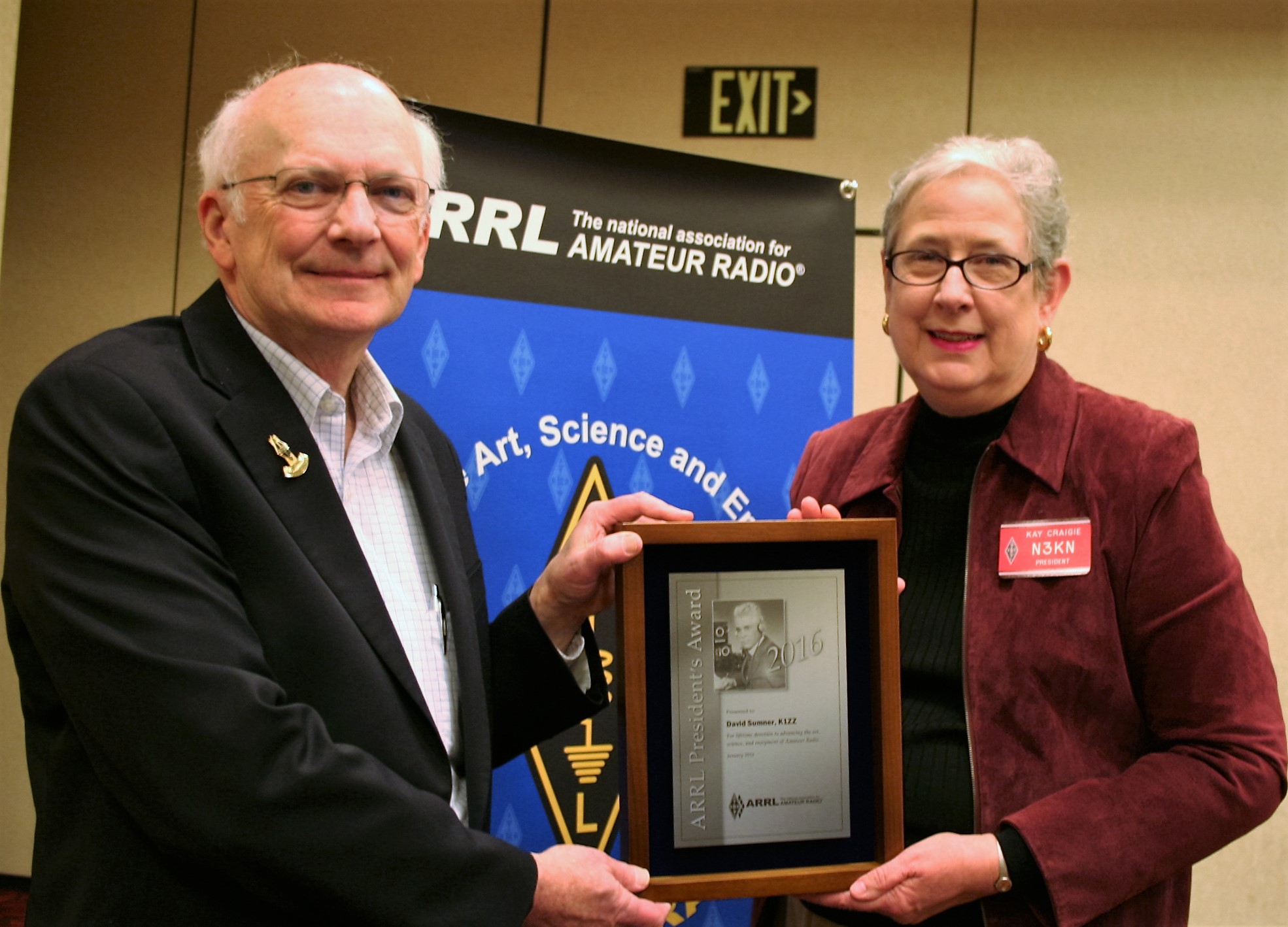
ARRL President's Award

Lots of comings and goings at the ARRL. Dave Sumner is retiring this year as CEO, and has just received the ARRL President's Award for his many years of service to the League, presented by outgoing President Kay Craigie.

Sunday, July 20, 2014

ARRL 100: Report from Hartford


The first 100 years of Amateur Radio (and the American Radio Relay League - ARRL) is now history. The National Centennial Convention closed that chapter yesterday in Hartford CT. The second chapter is slowly opening.

The League put on a great conference in the Connecticut Convention Center; a fine venue in an interesting city. If you hiked around the newly developed riverfront, you would come to the the Old State House and a lively street scene. Great food and music!

There is an occupational hazard in ham radio and the ARRL. We sometimes focus too much on how we got here – our 100 year history – and not so much on where we are going. A lot of us are old-timers with nostalgic thoughts about how we got into the hobby long ago, our first rigs, the controversies along the way, "Rotten QRM" and so on.

Conference presentations did try to look ahead. Craig Fugate KK4INZ, FEMA Administrator, gave a compelling view of Amateur Radio as a vital backup emergency service "when all else fails". The challenge is to go back to the future – to be sure you can communicate when the public telephone and data networks are completely off-line. High technology comm. systems have proven to be surprisingly brittle, just when you need them most. It was amazing to receive that kind of endorsement, personal and professional, from a high place in government.

Joe Taylor K1JT gave another keynote talk that was billed as future-oriented. Joe is a friend who is well-known as the driving force behind the WSJT weak signal communications software, a physicist and astronomer, a regular guy, and, yes, a Nobel Laureate. Even K1JT's "futures" talk was heavily biographical and historical, describing a moving personal journey that brought the audience to its feet.

Both Fugate and Taylor were given well-deserved ARRL Medals of Honor.

Futures? I found the forum talk by Frank Lloyd AA7BQ to be the most challenging. Frank is the guy behind QRZ.com, the well known callsign database and forum site. From humble beginnings redistributing the early FCC tape-based callsign data, QRZ has grown into a leading edge cloud-based Internet service, with a staff of 4 or 5 people. The site claims to be the number one Amateur Radio web site.

QRZ.com's basic service is free, but it has a number of subscription services at prices $20 per year and up. The latest is an on-line logbook service and accompanying award program. The front-end website for logging and log analysis looks quite appealing. I expect it will be a serious competitor with other on-line services like LoTW and eQSL.

What might that mean for ARRL's future? ARRL still needs to continue to reinvent itself for the Internet era. Increasingly, ARRL's identity will (and should) be as an Internet service provider – in addition to the traditional member service, technical, and regulatory roles. The League does have its big website (with lots of good content, but lots of problems, and only a weak forum system) and the LoTW program. LoTW is widely considered to be security-heavy and user-unfriendly, aimed at qualifying for ARRL awards, but having little "social media" orientation. All that said, it does serve an important role!

http://www.arrl.org/arrl-second-century-campaign
One of the problems for ARRL is finding a new revenue model to support an aggressive Internet program. The $39 dues are amazingly low, given all the services that are supported not to mention QST. Many hams are happy to pay another $39 or more to QRZ.com or similar services. That should be sending a message to the League.

Transitioning to digital publications is hard for any print publisher, but it is necessary. Digital QST is a first step, but it still has too many limitations that come from the print world. Where is Digital QEX – and other kinds of digital newsletters or forums on special topics?

That's the big challenge. The League has to stay relevant on the Internet! Oh, and on the bands, too. :-)


Wednesday, October 23, 2013

ARRL Handbook: Cool, but Heavy Reading


Yesterday, I got my engraved hardbound copy of the 2014 (Centennial) Handbook.  It's the Ham Bible, they say, but it's big!


In fact, it weighs in over 6 lbs (2.7 kg). This makes it rather difficult for reading in bed, especially for us geezer types.  (Note for reflection: the actual Bible, as usually printed, is much more user-friendly!)

My solution: upload the CD right away to Google Drive.  (privately) That makes it available wherever I'm likely to be.  And with the Nexus 7, it's quite manageable while reclining!

So apart from the cool-factor of having this tome on my bookshelf, it would be just as well to get my Handbook via Google Drive directly -- or some other network based solution.

(We might ask what it would be like if each chapter of the Handbook had an accompanying online wiki where readers could add their material.  Mixing curated and non-curated content would be a challenge, but a worthy one!)

At right is the classic ARRL graphic (ca 1975) that I seem to carry around in my head.  A very nice portrayal of the then-modern ham!

And strangely enough, it must be one reason while I frequently go up to HQ, and why I'm thinking about the Second Century Campaign.

Friday, September 07, 2012

Reinventing Ham Radio? - Pogue

"You might think that we’ve exhausted every variation on electronic communication — text, audio, video — but you’d be wrong. A new one is quietly winning over millions of gadget fans. They’re free apps with names like Voxer, HeyTell and Zello, and they really do mess with the rules of the game."  -- David Pogue, New York Times
It's Ham Radio (e.g., D-Star) without the license.  Seriously,  Amateur Radio may need to lose some of its exclusive focus on FCC-licensed communications, to bring in a little new energy.

Sunday, June 24, 2012

Amateur Radio and Innovation in an Age of Austerity

Eben Moglen
Why would I watch an 88 minute YouTube speech by Eben Moglen?  It was John Naughton's hearty recommendation for  his talk given at F2C:Freedom to Connect 2012, Washington DC on May 22.

In a nutshell, Moglen gives an eloquent and provocative story about how what will save us all, economically, is innovation, and innovation in these economic times (austerity all around) will only succeed if we promote free (as in free speech) software and place tools for experimentation in the hands of young people around the world. (Jabbed for their closed nature: Apple, Facebook, etc.)  We need control of our own servers. (and logs!) Powerful stuff that folks in the Linux / GNU camp can all believe in.

So should everybody go spend an hour and a half on this?  Maybe not, but there were several comments at the end of the Q&A session that were related to Amateur Radio.   An unexpected reward for persevering!

Some folks brought up the Maker Movement as an example of a community that is developing along the lines Moglen is describing.   Then (at about 1:17:00), Doc Searls confessed that he had started out in life as a radio amateur, and he called on an audience member, Dwayne Hendricks (WA8DZP), to give a short spiel on Amateur Radio - no, it's not dead, and in fact it provides a great platform for open technology development.

Dwayne relates some of his work, suggesting among other things that hams can develop platforms for non-hams to use.  (This raises some questions for me!)  He also takes an unfortunate dig at the ARRL in these comments to this professional internet/computing audience.  (In another setting, his point about ARRL's stance vis-a-vis innovation deserves discussion.)

For your convenience, here is the full video:


Thursday, May 24, 2012

QST & digital QST


The new digital QST edition is now on the web, accessible to ARRL members.  It's a good effort -- at least if you like the new web magazine reading experience.   It is being provided to members as a no-extra-cost addition to the traditional print version.

I hope the pdf version won't go away completely.  That's the format that appears on the annual publications CDROM and on the QST web archives up through 2011. The new format is fine (well, if you like it!) for on-line reading and limited off-line reading, too, but it is a proprietary and DRM-restricted format that probably won't be convenient (if readable at all) 50 years from now.

I was interested in the new QST logos that are cropping up.  There are several variations. One is at the top of this post (I understand it is for the iOS app), and here is another:


But I like to look through the QST archives to how QST presented itself in the very earliest days.  The first "logo", from 1915, was this neoclassical marvel:


Then, in the late teens and into the twenties, you might have seen this one.  (Color added.)


This is the classical logo for me.  Its block lettering and at least some of the lightning bolts continue into the modern era.  The slogan now says "Amateur Radio" instead of "the Wireless Amateur".  I like this old graphic, but I'm pleased that there is so much continuity in today's version.

Finally, take a look at the first digital QST cover (June, 2012):


Bold and hyperactive design, and presented twice for good measure!

Friday, February 17, 2012

ABCs of SDR

The new book is out.  It's a concise low-math (almost zero math) description of what SDR (software defined radio) is all about, for the general ham radio audience.

The short message:  It's the main technology at the core of about every HF radio you can buy these days.  If a radio has "IF DSP" it normally has an SDR back end.  Front ends vary, from minimal ("pure" SDR) to conventional, but the digitization and digital signal processing is mostly the same.

Order from ARRL or your favorite bookseller.

Monday, October 18, 2010

Spectrum and Band Occupancy

Dan, KB6NU, has some good reasons to worry about 300-3000 MHz competition for amateur bands.
American Radio Relay LeagueImage via Wikipedia
Right on.  At least frequencies below 300 MHz are under less pressure, which is a relief to us HF & 2M troglodytes.  Still, vigilance is required.  Support ARRL.

There is a problem with the VHF and higher bands that doesn't get a lot of attention.  Amateurs are not very good at utilization.  The bands are almost always completely empty, and this makes them targets for commercial use.  Around here in CT, the 2M repeater segments are mostly allocated and unavailable for new applications, but they are still unused most of the time.

Multiple PSK31 transmissions on the 20m digimo...Image via WikipediaBy contrast look at 14.070 - 14.073 kHz. I can often copy dozens of PSK31 QSOs in progress there in 3 kHz of spectrum.  Also look at the cell/CDMA bands that support 100s of "QSOs" in a few MHz all the time.  Hams do need to pay more attention to band occupancy.

Sunday, July 25, 2010

QS1R SDR QST Review

My first-ever product review for QST is coming in the September, 2010, issue.  This is for the Quicksilver QS1R Software Defined Radio.  ARRL members may find it here. [pdf]

Monday, May 31, 2010

Memorial: The Audion


One of the neatest displays at ARRL headquarters is in the W1AW station entry -- a couple of early radios using the DeForest Audion. You have to know where to look for them. The League is many things, but it lacks a real museum curator.

Remember the Audion here. (Gizmodo)

Tuesday, April 13, 2010

It's alive!


The brand new long-in-coming ARRL website is up! It is at www.arrl.org, naturally.

I had a tiny role in preparing some of the pages. Hopefully you will not see my fingerprints anywhere.

It has been a very ambitious project. Like war plans, we will see if the site survives contact with the enemy. (= users!)

It looks pretty good to me, and we can only expect it to improve.

Thursday, March 25, 2010

A Little Look-up

Today, I took some time out from my volunteer gig at the ARRL Laboratory to explore the League's files of Amateur Radio Callbooks that go back to the founding of the hobby -- when giants strode the earth. As far as I know, no one publishes a printed Callbook any more -- there are CD-ROM versions, and the information is available through quite a few online services. The print volumes are great as archives, but unfortunately no one has undertaken the big (!) chore to scan and OCR the volumes for general access. (Hamcall.net will let you look up a callsign for 1960 and a number of the more recent yearly databases.)

Anyway I found the first Callbook instances of my 4 callsigns: K5MXF (1958), WA1OCT (1971), WB6YBQ (1974), and AA6E (1979). Like many old timer hams, I did not keep my early license documents and my memory of exact dates was fuzzy. It's good to have them now.

The League has a great archive, but alas there is no one tasked to retrieve data for members. It might make a good service job for the right volunteer in the Newington area.

Note added: If you try hamcall.net for historical data, you need to be registered (free) and logged in. Go to http://hamcall.net/call, enter the call sign and check the box "Look up this callsign from all available database years".

Sunday, February 07, 2010

Thursday, January 14, 2010

Volunteering at League HQ

Here's the scene at the ARRL Headquarters lobby, as seen from the volunteer Tour Guides' nook. We are a lot busier today than normal, because of various committee meetings and other activities around the Board meeting this weekend.

I've been a ham (amateur radio operator) now for 52 years, enjoying many facets of the hobby -- from Morse Code ("CW") to Open Source Software. In the past year, I've been volunteering at ARRL HQ, as a Tour Guide.

Tour Guides are an interesting lot. They are generally retired folk, like me, who have a bit of time available and who have a long involvement in the hobby and a commitment to the League. I see most of them only rarely, since our slots don't overlap. (I have Thursday mornings, if you'd like to drop in.) The League's coordinator, Diane Petrilli, does know how to keep us motivated, with an occasional group lunch, and a certain amount of "swag". Along these lines, one the best benefits is a special discount at the ARRL bookstore.

The real reason to be a Tour Guide, for me, is to meet a very interesting cross section of radio amateurs, along with spouses, friends, and family members. These are mostly "drop ins" who are visiting in the Newington CT area. Generally, they are long-time hams and League Members. Some of them are quite capable of giving me the tour -- and are happy to do so! On the other hand, there are a few who are just getting interested in the hobby and who need some encouragement which I'm happy to provide.

Tour Guides provide an interface between the visiting public and the ARRL organization, so the flip side for us is having the chance to learn what's what at the League itself. Many hams, myself included, have grown up thinking of the ARRL Headquarters as something like the "mother church". The first visit here is like a pilgrimage to hallowed ground, the historic station W1AW, the editorial offices of the publications like QST, and home of many services for members. I haven't seen anyone kneel to kiss the ground yet, but you get the idea.

Another good reason to hang out at HQ is the chance to operate W1AW. It's a thrill to be a "rare one" on the amateur shortwave bands. It's easy to create a "pile-up" of operators wanting to talk to this classic station. Just as interesting is the chance to use your choice of state-of-the-art radio equipment. It's one of the few ways to "try before you buy".

Today, with the Board of Directors in town, there don't seem to be any normal visitors. A good time to meet some Directors, enjoy the Board's snacks and coffee, and pursue the Internet.

Sunday, October 11, 2009

Nutmeg Hamfest 2009

The Connecticut Nutmeg Hamfest for 2009 went on in glorious fall weather on October 11.
Note: Click on photos for more detail.

A hamfest always begins with checking out the competition's mobile installations. Relatively few HF installations compared to Dayton.


Always enter by way of the flea market to see what's up. People noted that the larger stores and manufacturers were absent this year. There were still a lot of "mom and pop" flea market vendors.


This was the ARRL Connecticut Convention. Left, our Director Tom Frenaye, K1KI. Right, Section Manager Betsey Doane, K1EIC.


A small, but engaged audience for the League Forum.


Joel Hallas, W1ZR, gave a popular talk on multiband antennas. Guess which favorite antennas really don't work very well on the HF bands!

Another rapt audience.


The flea market had some beautiful nostalgic equipment on display. No, it wasn't selling very fast, but it was nice to look at and reminisce. I got a Boonton grid dip meter, just like the one I used 35 years ago!


The Shore Point club (West Haven) had its very snazzy emergency communications trailer on display. It doesn't look like it's worked through many disasters yet!


The Shore Point trailer command desk. Two people, five microphones, and then some.


I thought this was the highlight of the show. It is W1RT's HF - 10 GHz hill-topping van. An amazing collection of gear, all oriented to VHF, UHF, and microwave contesting.


Overall view of the vehicle area. There was also a converted ambulance from the Danbury group.

I didn't know they gave license plates for Unix veterans, but here is one I found:

Friday, September 25, 2009

Commercialization: ARRL Does a Good Thing

Today, the ARRL Board of Directors released fascinating guidelines on the "Commercialization of Amateur Radio: The Rules, The Risks, The Issues". This paper results from the apparent growing problem of some for-profit or non-profit organizations looking to Amateur Radio frequencies and equipment as cheap solutions for their disaster communications needs, without very much regard for the FCC regulations or the culture or history of Amateur Radio.

The basic points, in my reading: (1) Amateur Radio operators, by FCC regulation and with narrow exceptions, are volunteers and are normally not allowed to communicate when they have a pecuniary interest, for example, on behalf of their employers. (2) Organizations may not use Amateur Radio frequencies when there are alternate licensed (or unlicensed) radio services that can be used, such as the Land Mobile or Commercial Mobile services. (3) Provisions in the FCC regulations suspending some normal rules during time of disaster or in emergency situations do not allow organizations to plan communications on Amateur frequencies without obeying FCC licensing regulations.

The ARRL Board does not cite specific instances of real or planned abuse or exploitation of Amateur frequencies, but we can guess what they might be. An organization wants to assure business continuity by using ham equipment and frequencies, either with or without help from licensed Amateur operators. There might be many variations of this picture, ranging from purely commercial entities to non-profit charitable organizations that want to provide community services, but with in-house paid personnel, with or without licenses. In any case, the nature of the Amateur Radio Service and its frequency allocations would be put in jeopardy by operations that are making an end-run around inconvenient FCC regulations.

The League Board makes a clear and urgent call for Amateurs and Amateur organizations to read and understand the relevant FCC regulations, and to carry the message to all forums where emergency communications services are being planned and coordinated.

Beyond their informative and persuasive arguments about appropriate use of Amateur frequencies, I though the Board's consideration of the roles of the FCC, the Amateur Radio community, and the ARRL itself to be very interesting. We must remind ourselves that Amateur Radio is largely a self-policing enterprise. It is unrealistic and unwise to expect the FCC to specify precisely which uses are acceptable or not acceptable. (Be careful what you ask for!) It is up to each of us to understand the law and the regulations and to develop a consensus of what kinds of operations to support or to oppose.

(Reading between the lines, now.) The scary scenario we want to prevent is having large governmental, non-profit, or for-profit organizations, see how sweet the inexpensive, relatively informal world of Amateur Radio is, as a way to satisfy their urgent needs. In some cases, Amateur groups may be only too willing to accept generous donations of equipment and other support in the name of emergency communications operations. In reality some of these large organizations have a lot of economic and political power and could turn around and actually threaten Amateur Radio spectrum in the future, by co-opting our frequencies in the name of emergency services.

The commercialization issue is just one example, to my mind, of the growing tension between Amateur Radio, which is traditionally shoe-string, informal, improvisational, and local, as against the well resourced, highly structured, and even quasi-military environment of large-scale emergency response organizations and corporations. Good luck to the ARRL, and to us all, in working that one out.

Update: I should explain that I've been a ham for 50+ years, but apart from the odd Field Day, have had little involvement in the emergency communications side of Amateur Radio. (I admire those who do!) I like DX and casual contacts using CW, PSK31, and even SSB. And I do other stuff that you can read about on this blog.

Tuesday, December 09, 2008

ARRL's role (recruiting hams vs members)


Dan KB6NU is right to draw attention to the (radical?) proposition that ARRL is not identical with ham radio. I tried to make that point in my comments on the ARRL Strategic Plan.

It's not just a question of hubris. It's a hard problem, since the League has a wonderful history of co-evolving with Amateur Radio from the earliest days. Many of us regard it as the primary voice of A.R., especially for regulatory and PR matters. On the other hand, the League is a big-time technical publisher and purveyor of services to hams, and it has parochial competitive interests, as any organization would. On the whole, I think they do reasonably well at making a balance and leaving some oxygen for others to breathe. But it was clear in the old strategic plan, that the Board and Management have trouble seeing their organization as something other than the soul of ham radio.

Thursday, December 04, 2008